
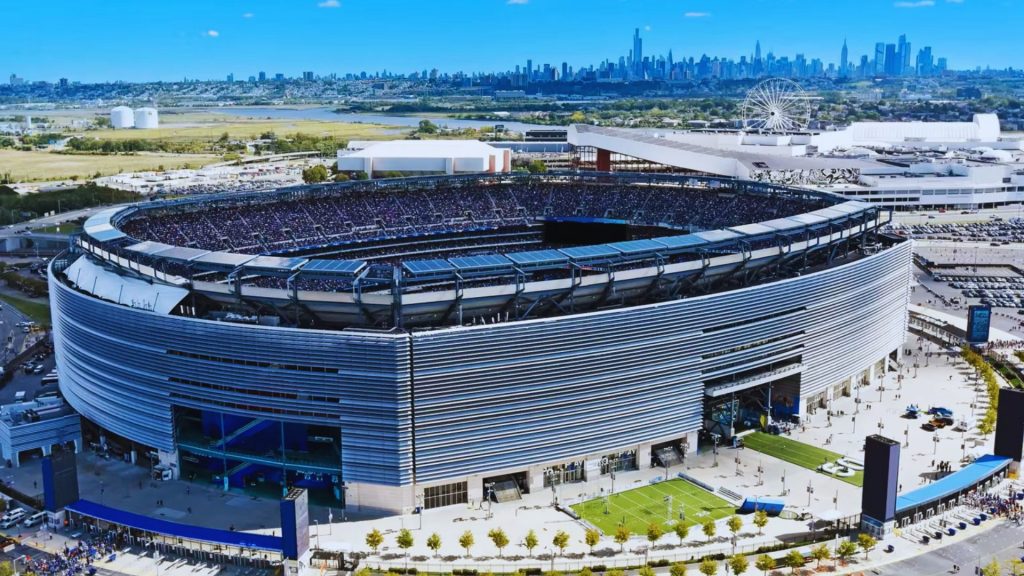
There is a certain kind of project that makes every engineer stop scrolling. For us at NOHMIS, the transformation of MetLife Stadium in East Rutherford, New Jersey, ahead of hosting the 2026 FIFA World Cup Championship match this month, is exactly that kind of project.
We will admit, MetLife Stadium is also home to the New York Jets, longtime rivals of our Miami Dolphins and a team we typically only cheer against twice a season. Under normal circumstances, saying something nice about that building feels a little like accidentally clapping when the Jets score. You did not mean to, but now the whole section saw it, and there is no explaining your way out of that one. Lucky for us, this is the other kind of football, the one played with a round ball and no fourth-and-goal, so we can retire the rivalry for a few paragraphs and just talk shop like the engineers we are.
We were not part of this one, and that is exactly why we wanted to write about it. NOHMIS is an engineering design firm rooted in South Florida, working out of our Pompano Beach office nearly 1,300 miles from East Rutherford. All the credit for this stadium belongs to the structural engineers, contractors, and specialty trades who actually brought it to life, several of whom we will introduce by name as this post goes on. We are sharing this simply because we are engineers at heart too, and when we see work this thoughtful, this well sequenced, and this well built, we cannot help but want to celebrate it alongside the rest of our industry.
A Stadium Built to Host Almost Anything
MetLife Stadium opened in 2010 as the shared home of the New York Giants and New York Jets, replacing the aging stadium that stood before it. At roughly 1.6 billion dollars, it was the most expensive stadium built in the country at the time, delivered with structural engineering from Thornton Tomasetti and construction led by Skanska. In the years since, it has hosted a Super Bowl and multiple international soccer tournaments, and now it carries the honor of hosting the 2026 FIFA World Cup Championship match, along with several other matches earlier in the tournament. Because of FIFA’s rules on corporate sponsorship, the venue even goes by a temporary name during the tournament, New York New Jersey Stadium, a small detail that says a lot about how seriously this event is run. (Source: MetlifeStadium)
Reshaping the Field for the World’s Game
An NFL field and a FIFA regulation pitch are not the same size, so hosting World Cup matches meant the stadium itself had to change. Beginning in early 2024, crews took on a renovation of the lower seating bowl to widen the playing surface while keeping the stadium’s NFL capacity and layout intact. Four corners of the original precast concrete seating bowl were demolished and rebuilt using a new modular steel composite seating system, along with the related mechanical, electrical, and plumbing work needed to support it. Roughly 1,740 permanent seats were replaced in the process. (Source: Wikipedia)
What stands out to us is how the work was sequenced. The project was split into two phases so the stadium could keep hosting NFL games and other events without major interruption. That kind of phased construction sequencing, protecting an active facility while rebuilding parts of it underneath the same roof, is one of the more difficult things to plan well on paper before a single beam moves. It takes real coordination between the structural drawings, the MEP plans, and the contractors executing them to pull off without a hiccup, and from what has been reported, this team pulled it off.
The Details Fans Never Notice, and That Is the Point
Some of the most impressive engineering in a stadium this size never shows up in a highlight reel, and honestly, that is exactly how it should be. The day an expansion joint becomes the main character of the broadcast is the day something has gone very wrong. Take the structural expansion joints running through the concourses and seating bowl, roughly 4,200 linear feet of them, engineered to stay watertight while handling constant movement, foot traffic from tens of thousands of fans, and the load of delivery carts and equipment. The system anchors to a central spline rather than directly into the concrete, which helps it stay quiet, resist wear, and avoid the kind of hard connections that loosen over time. It is unglamorous work, but it is exactly the kind of detail that determines whether a structure performs well for decades or starts causing headaches within a few years. (Source: Sika Emseal)
What makes this even more impressive is the scale each joint has to answer for. The seating bowl runs roughly two miles around in circumference, yet the entire structure is separated into just four sections by those 24-inch wide structural expansion joints. Four joints carrying that much structural continuity while still accommodating movement across a frame this large is a testament to how deliberately the whole system was engineered from the start. (Source: Sika Emseal)
We appreciate this kind of thinking because it mirrors how we approach our own structural and MEP plans here in South Florida. A building or a stadium is only as good as its least visible connections. Getting those right on the drawings the first time is what separates a structure that ages gracefully from one that becomes a maintenance problem.
One Championship, Several Stadiums, the Same Standard
MetLife Stadium is not the only 2026 World Cup venue carrying this level of engineering rigor. Thornton Tomasetti’s structural and construction engineering work also touches Lincoln Financial Field in Philadelphia, BMO Field in Toronto, Hard Rock Stadium in Miami, and SoFi Stadium in Los Angeles, each renovated or reinforced to meet the demands of hosting the world’s largest sporting event. Seeing Hard Rock Stadium on that list is a nice reminder that this tournament touches our own state too, and that Florida’s venues are being held to the same exacting standard as the rest of the country’s biggest stages. (Source: Thornton Tomasetti)
Our Halftime Takeaway
Whether it is a stadium built to host a World Cup championship or a mid-rise on Florida’s coast, the same principles hold true on the drawing board. Plan for the load the structure will actually carry, sequence the work so it does not disrupt what is already running, and never treat the details as an afterthought. Those are the standards we hold ourselves to on every set of plans we produce for clients in Broward, Miami-Dade, and Palm Beach Counties, and it is genuinely exciting to see them play out on a global stage right now.
Partner With NOHMIS
NOHMIS provides full-service Architecture, Structural & MEP Engineering to clients across South Florida, along with Inspections and Seawall and Docks engineering. If your next project needs a design team that treats every connection, joint, and system on the plans with the same care as the engineers behind the world’s biggest stadiums, we would welcome the conversation.
Explore our Structural Engineering and Architectural Design services, or reach out below to start a project.
Contact:
NOHMIS Design, Engineering & Inspections
2195 N. Powerline Rd, Suite 2
Pompano Beach, FL 33069
+1 954-591-8361
Services@NOHMIS.com
www.nohmis.com
References
MetLife Stadium: MetLife Stadium Selected as Host Venue for FIFA World Cup 26™ Final | MetLife Stadium
Meadowlands Gets Major League Expansion Joint Covers: emseal.com/project/meadowlands-expansion-joint-covers
FIFA World Cup 2026 Host Stadiums Showcase Thornton Tomasetti Engineering: thorntontomasetti.com
Disclaimer: This article discusses a stadium and tournament that NOHMIS was not involved in engineering, designing, or inspecting. All project facts are drawn from public reporting by Wikipedia, Sika Emseal, and Thornton Tomasetti, linked in the text above and cited again below, and are shared here purely as industry commentary and appreciation.