
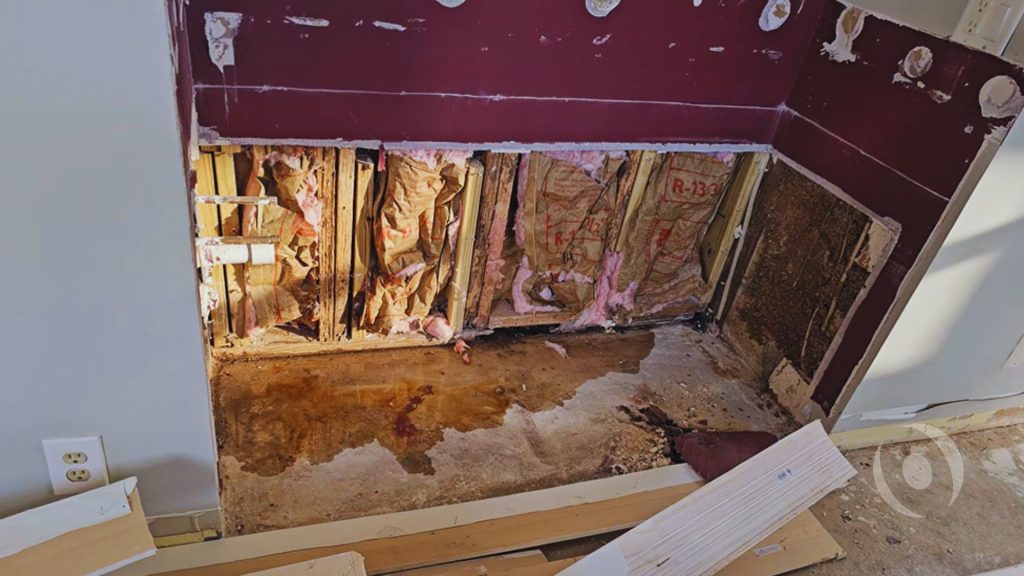
If you live west of I-95 in South Florida, particularly in communities that push toward the Everglades, your property sits on land with a very different story than the rest of the region. And if you are seeing water ponding in your yard, or worse, moisture coming up through your concrete slab or foundation, that story matters a great deal.
At NOHMIS Design, Engineering & Inspections, we get calls about this regularly. Homeowners are often left confused, uncertain of the cause behind these issues.
The Everglades Connection
Much of western Broward, western Miami-Dade, and the interior communities of Palm Beach County were built on what was originally Everglades. The Florida Everglades once contained the largest single body of organic soils in the world, covering over 3,100 square miles. The soils in those areas are dominated by peat and muck, known technically as Histosols, formed over thousands of years from partially decomposed sawgrass, water lilies, and other wetland vegetation. (Source: USEPA Everglades Peat Study via IntechOpen)
When these communities were developed, builders brought in fill material to raise the land. In many cases, that fill came directly from the site or from nearby excavations in the same organic-rich terrain. The result is that under and around many of these homes, the soil profile can include varying amounts of peat and muck, though they should not be there as a requirement for construction, usually removed. These materials that retain water exceptionally well and drain poorly, behavior very similar to clay but driven by organic content rather than mineral particle size. Britannica notes that when organic soils like these are drained or disturbed, they deteriorate rapidly. (Source: Britannica, Florida Drainage and Soils)
This means the ground beneath and around your structure may be holding water long after a rain event ends, or even without a rain event at all.
If you suspect your fill material has a high organic content, a qualified geotechnical engineer can perform soil testing to confirm it. Soil borings and laboratory analysis will identify peat, muck, or other high-organic material in your soil profile and quantify how it is affecting drainage and load-bearing behavior. This kind of testing takes the guesswork out of the investigation and gives engineers and contractors a factual basis for any remediation plan. You can find geotechnical testing professionals in our preferred partners directory at NOHMIS Preferred Partners: Geotechnical Engineering & Testing.
Signs Your Home May Have a Soil Saturation Problem
- Standing water after rainfall
- Soft ground around foundation
- Moisture appearing on flooring
- Efflorescence
- Foundation cracks
- Moldy odors
- Buckling floors
- Repeated moisture issues
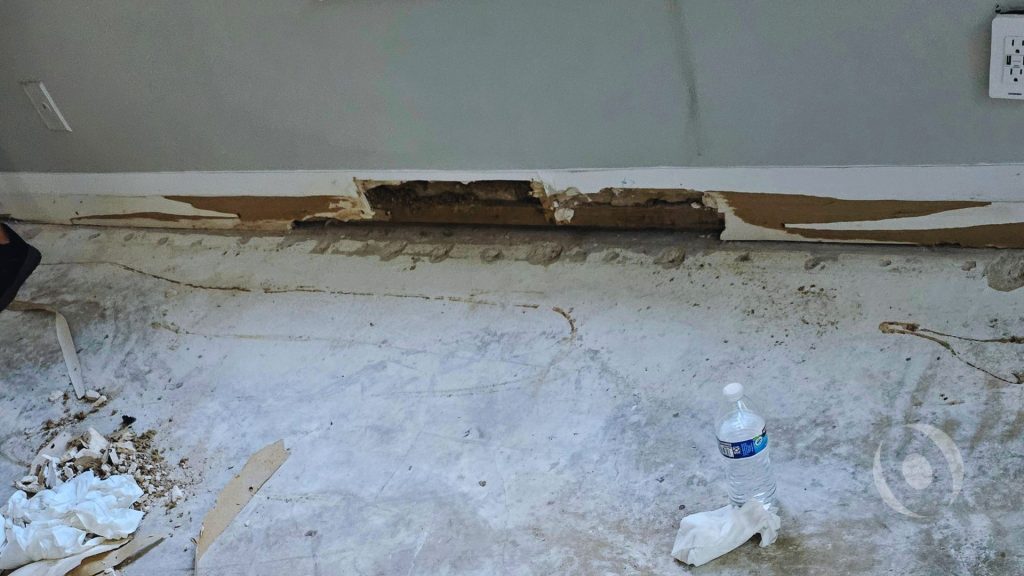
So Where Is the Water Actually Coming From?
When a homeowner tells us water is coming up through their concrete slab or foundation floor, we work through several possible sources before jumping to conclusions.
Start with your water bill. For a family of four, a monthly water bill under $100 generally means you do not have a significant active supply leak on your property. That does not eliminate plumbing as a cause entirely, but it makes a large leak much less likely. If your bill is indeed over $100 and into the $150+ territory then we recommend consulting with a plumber that can detect leaks. You can find plumbing professionals in our preferred partners directory at NOHMIS Preferred Partners: Plumbers.
Consider your neighbors. Water does not respect property lines. A supply leak, a sanitary leak, or an irrigation leak on a neighboring property can saturate the shared soil between parcels. Dense residential subdivisions are especially vulnerable to this because the lots are tight and the water tables respond to conditions across multiple properties, not just your own.
Look at your irrigation system. This one catches a lot of homeowners off guard. Many homes in South Florida were built with thin-walled irrigation pipes that were inexpensive at the time but have become brittle and crack under soil pressure, root pressure, and age. Irrigation runs on a timer. A small crack in a buried line can silently deliver hundreds of gallons per week directly into the soil without ever surfacing. By the time anyone notices, the soil profile is already saturated on a nearly continuous basis.
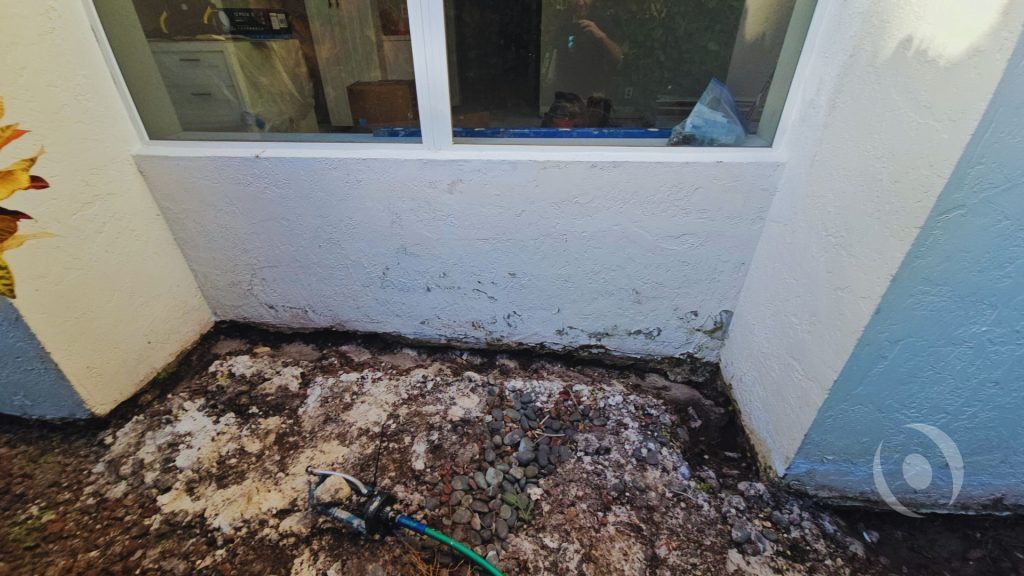
Look at the ponding pattern. If water ponds consistently in your yard, especially near the structure, that is not just a surface drainage issue. Water seeks its own level. If the soil at the surface is saturated, the soil beneath your concrete slab foundation is also saturated. That is the key insight.
What Is Hydrostatic Pressure, and Why Does It Damage Concrete Slabs and Foundations?
Hydrostatic pressure is upward water pressure that builds beneath a concrete slab or foundation when the surrounding groundwater level rises. . Water weighs approximately 62 pounds per cubic foot. When saturated soil presses against the underside of a concrete slab, that force is real and significant. (Source: The Real Seal)
Residential concrete slab foundations were not designed to resist significant upward hydrostatic pressure. They were designed for gravity loads coming down, people, furniture, and the weight of the structure above. When water pressure pushes upward from below, it exploits every micro-crack, capillary channel, and construction joint in the slab.
Florida has one of the highest water tables in the country. During the rainy season, hydrostatic pressure builds up beneath slabs and creates stress that can produce cracking at the surface. If drainage around the home is poor, that pressure intensifies. (Source: Lux Cando Florida)
The sequence looks like this. Organic fill soils or clay-like muck hold water after a rain event. An irrigation leak adds more. The water table rises. The soil beneath your concrete slab foundation is now fully saturated. The next rain event or the next irrigation cycle adds pressure to an already full system. That pressure pushes upward. The slab resists until it cannot.
What Commercial Design Gets Right (That Residential Rarely Addresses)
When we design commercial structures in South Florida, if the existing flood elevation of the property falls below the current adopted flood elevation under FEMA’s maps, we are required to design explicitly for hydrostatic pressure. That means engineering the foundation system to account for upward hydrostatic pressure and groundwater forces.
Residential construction does not carry the same requirement in most cases. That gap in standards is partly why so many homeowners are surprised when this problem appears.
Flood elevations have changed, and your property may be affected. Broward County has updated its required base flood elevations as part of its long-range planning. You can check the Broward 2060 flood map here: Broward County GIS Flood Viewer. If your structure was built to an older flood elevation standard, it may now sit below the current required base flood elevation, which has direct implications for both hydrostatic pressure exposure and insurance requirements.
To make this comparison, you need to know the actual elevation of your finished floor and your surrounding grade. That means either a full property survey with topographic elevations or, at minimum, an elevation certificate prepared by a licensed surveyor. Without that data, you cannot accurately determine where your property stands relative to the current flood map. You can find a licensed surveyor through our preferred partners directory at NOHMIS Preferred Partners: Surveyors.
What Can Be Done
The good news is that this is a solvable problem in most cases. The approach depends on the severity of the saturation, the soil conditions, and the site layout.
French drains and perimeter drainage. A French drain is a trench filled with drainage rock and, typically, a perforated or solid pipe that intercepts groundwater before it reaches your foundation. Perforated pipe allows water to enter along its length and flow toward an outlet. Solid pipe collects water at one point and carries it away in full. Both approaches have their place depending on your site. The standard drainage rock for these applications is #57 stone, a clean, angular crushed aggregate sized between 1/2 inch and 1 inch. Its open-graded structure creates 30 to 40 percent void space, allowing water to move freely without clogging. (Source: Bovees.com, What Is #57 Stone)
Remove problem soils. If the fill beneath your landscaping or around your foundation contains muck, organic material, or other poorly draining soils, removing and replacing those areas with clean fill and drainage rock can make a significant difference. The goal is to eliminate the material that is holding water in the first place.
Address irrigation leaks. Audit your irrigation system. Look for soft spots, unusual green patches, or persistent wet areas that do not match recent rainfall. If lines are original to the home and more than 20 years old, a proactive inspection is worth the cost.
Swales and green drainage areas. If your municipality or HOA has designed swales on or adjacent to your property, those are engineered drainage features and need to be part of any drainage solution. More vegetated, permeable area on a property is generally better for natural infiltration. Sand is also an excellent drainage medium and is readily available locally.
Get a percolation test done. A percolation test measures the infiltration rate of your soil, meaning how quickly water moves through it. This data is essential for a civil engineer to properly size a drainage system. Without it, you are guessing.
Should You DIY This?
For minor surface drainage improvements, some homeowners handle it themselves. But if you are dealing with water intrusion through your concrete slab or foundation, persistent ponding near your foundation, or a property that was built on organic fill, the correct approach is to have a civil engineer design the drainage system. Drainage that is undersized, misdirected, or that pushes water toward a neighbor’s property can create new problems and, in some jurisdictions, liability.
NOHMIS does not provide civil engineering design services for site drainage, but we can help you determine the cause of the problem and coordinate the right team to address it. If you need a qualified civil engineer to design your drainage solution, you can find trusted professionals through our preferred partners directory at NOHMIS Preferred Partners: Civil Engineers.
Before doing any drainage work, check with your municipality and your HOA about permitted methods, required discharge locations, and whether a permit is needed. In many South Florida cities and counties, drainage modifications require review.
When to Call an Engineer
If you are seeing any of the following, it is time to get a professional involved.
Water staining, efflorescence, or moisture on your concrete slab or flooring surface, especially after rain events. Flooring that is cupping, buckling, or separating from the substrate. Persistent soil saturation or ponding near the foundation. Cracks in your slab that appear to be growing. A neighbor reporting similar issues in the same subdivision.
At NOHMIS, we specialize in structural assessments and inspections. We can help identify the source and extent of a moisture or hydrostatic problem, evaluate damage to the concrete slab, foundation system, or other structural components, and provide structural repair recommendations. We are a resource at the investigative and structural end of this process, and we work with qualified civil engineers and geotechnical professionals when a drainage design or soil analysis is needed. If you are unsure what you are dealing with, that investigation is the right first step.
You can reach us at nohmis.com or explore our network of trusted professionals for civil engineers, surveyors, and geotechnical testing services at NOHMIS Preferred Partners.
Contact:
NOHMIS Design, Engineering & Inspections
2195 N. Powerline Rd, Suite 2
Pompano Beach, FL 33069
+1 954-591-8361
Services@NOHMIS.com
www.nohmis.com
References
- Dreschel, T. W., Hohner, S., Aich, S., & McVoy, C. W. (2017). Peat soils of the Everglades of Florida, USA. In B. Topcuoğlu and M. Turan (Eds.), Peat. IntechOpen. doi:10.5772/intechopen.72925.
- The Editors of Encyclopaedia Britannica. (n.d.). Florida: Drainage and soils. Encyclopaedia Britannica.
Use the publication or updated date shown on the page, if one is provided. - Wright, A. L., & Hanlon, E. A. (2013). Organic matter and soil structure in the Everglades Agricultural Area (SL301/SS514). UF/IFAS Extension.
The publication was originally issued in 2009 and last revised in January 2013. Its later “reviewed” dates do not need to replace the revision year in the citation. - RSP Engineers. (n.d.). Peat and muck in Florida: What developers should know before building.
- Werner, A. (2022, May 25). Water seeping through foundation slab: Hydrostatic pressure & more. The Real Seal.
- LUX Foundation Solutions. (n.d.). Are hairline cracks in a concrete slab normal?
The page displays conflicting publication and update dates, so using “n.d.” is safer unless you can confirm the correct date from the site. - Bovees. (n.d.). What is #57 stone? Size, uses, and where to buy.